Empowering Canadians to address dietary restrictions

Within this project, I focused on creating the interactive online menu, which caters to the diverse dietary needs of Canadian diners. Nourish itself is planned to be a SaaS application helping restaurants build and publish interactive online menus. I led the end-to-end design process with the guidance of my professors.

Domains

User Research

Product Design

Brand Design

Team

Denise Amelia (Me)

Rahul Kapoor (Professor)

Matthew Sharpe (Professor)

Toolkit

Figma

Adobe Illustrator

Procreate

Duration

7 months

Growing up, dietary restrictions weren't something that stuck out to me

Coming to Canada from Indonesia, I was intrigued by the range of dietary needs and the many ways they impact people's lives. In fact, 43% of Canadians have dietary restrictions or preferences (Leger). But throughout all my interactions with them, one question stuck with me:

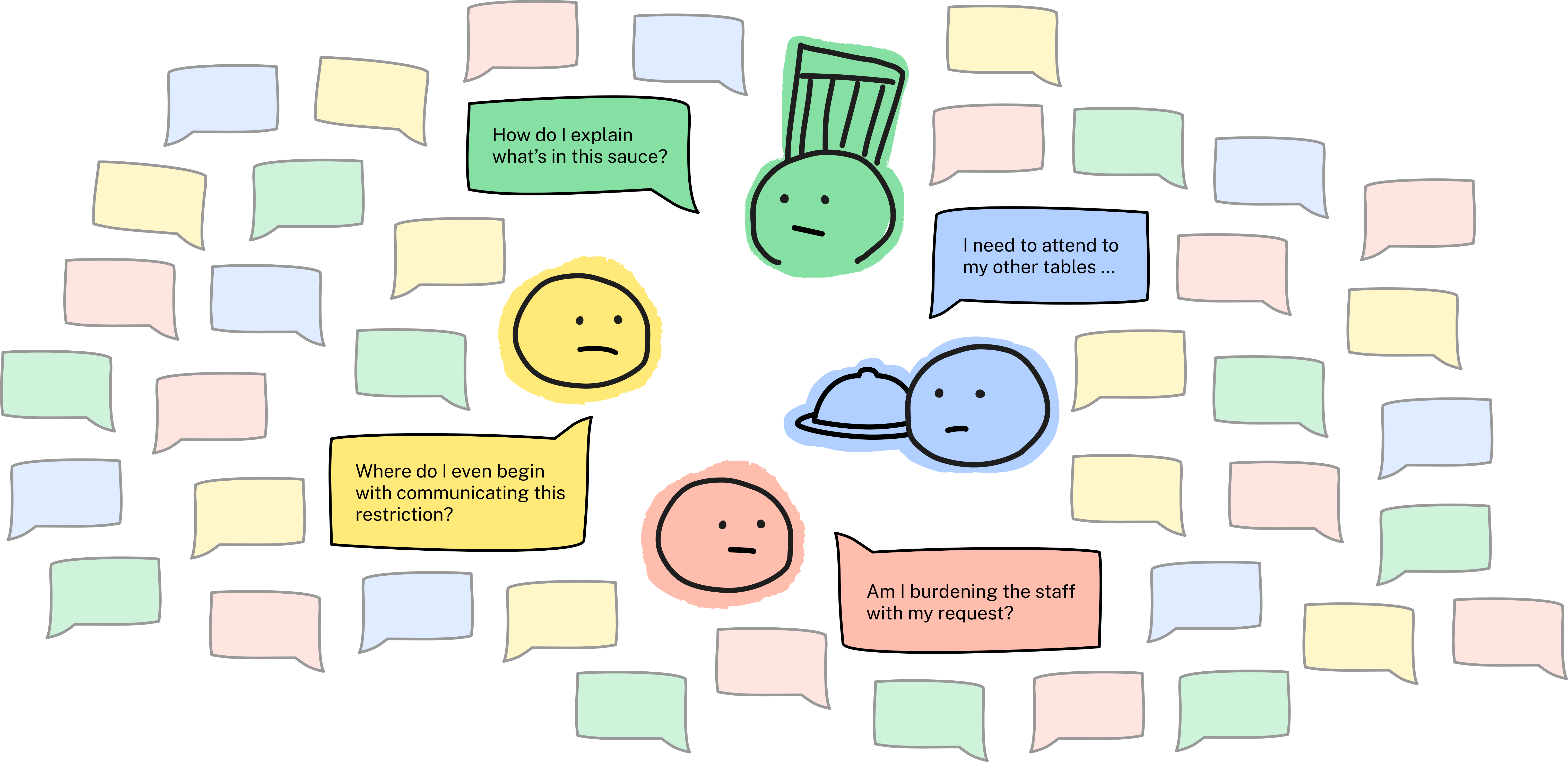
Dietary restrictions are collectively perceived as troublesome and extra work, causing friction when dining out

Through survey responses and online forums, diners and restaurant staff revealed various issues they face that arise from this perception. Addressing the issues of both diner and restaurant is crucial to prevent them from perpetuating each other's perceptions.

As food allergies continue to rise (NCHS Data Brief) and fewer younger Canadians dine out (Leger), the current perception around dietary perceptions will only make matters worse. The time is ripe to reassure Canadians that dietary restrictions are not a barrier to the dining out experience.

How might we dispel perceptions of dietary restrictions as troublesome and extra work to benefit Canadian diners and restaurants?

Introducing ...

the menu-building platform integrating dietary restrictions as a core consideration, designed to create information, foster inclusion, and simplify provision.

↓ Keep scrolling to see how I got here!

This project was carried out in two phases

Research & Ideation

Understanding the problem space, converging onto a specific issue to solve, and ideating solutions.

Development & Iteration

Validating solution concepts, creating a high-fidelity prototype, and getting feedback from users.

The course acquainted us with 30+ research and design methods and while they all helped advance the project, only the key ones are highlighted in this case study.

I started my exploration guided by two research questions

(1) How do diners and restaurants experience and approach dining out with dietary restrictions?

To answer this question, I surveyed 28 participants involved in the service of dining out, including diners with dietary restrictions, servers, chefs, and dining companions.

21%

Diners

18%

Servers

7%

Chefs

54%

Dining Companions

This participant sample is not as representative of the target population as I'd like, so in the future, I'd seek out more perspectives from diners, servers, and chefs.

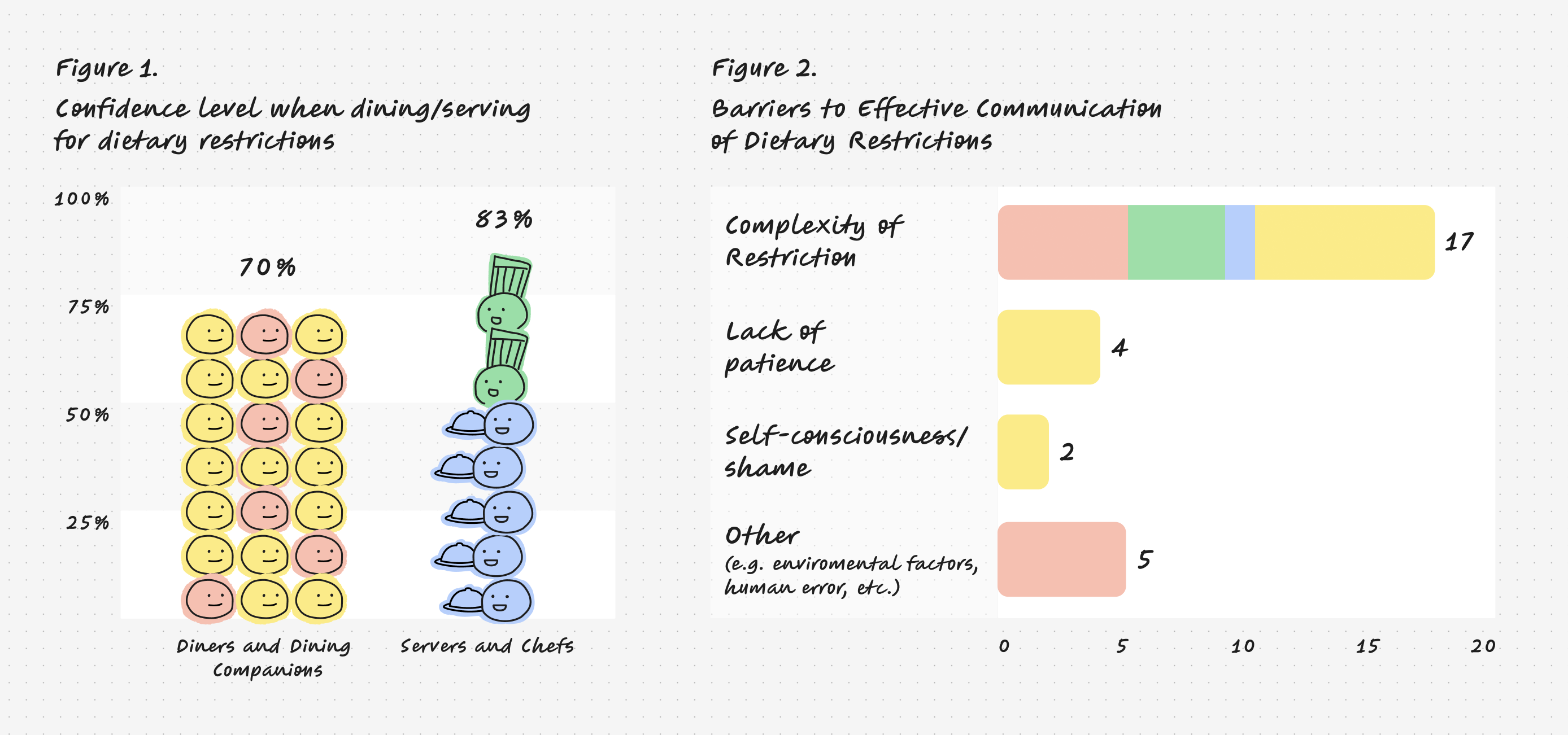
  • Diners and dining companions are 70% confident that the restaurant will follow their dietary restrictions whereas servers and chefs are 83% confident of meeting that expectation.

  • Members of each demographic cited "Complexity of Restriction" as a barrier to the effective communication of dietary restrictions, revealing a prominent issue to address.

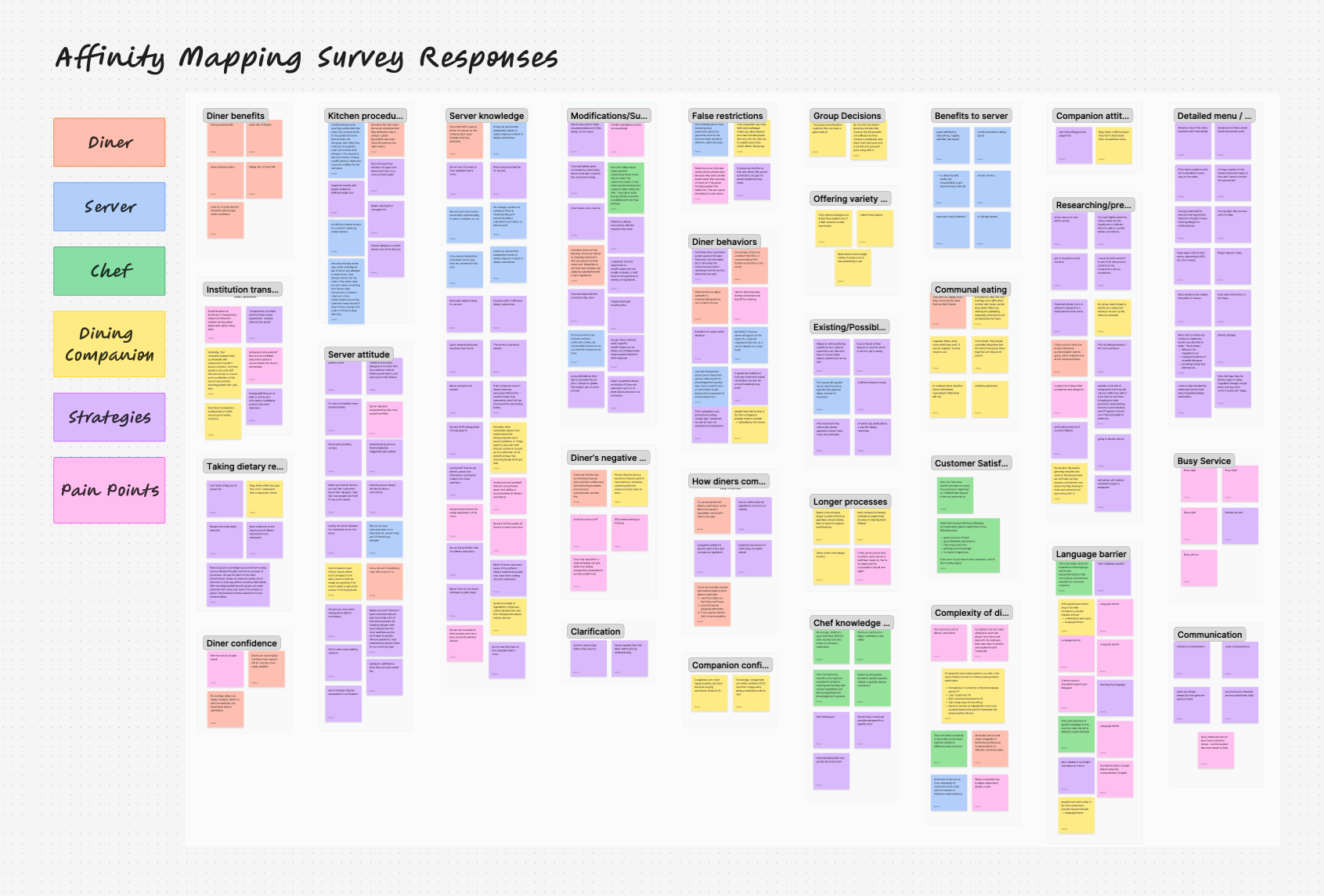
Participants also shared positive and negative experiences in the survey's open-ended portion. These responses were organized into an affinity map, revealing prevalent themes including "Server Attitude & Knowledge" and "Pre-visit Menu Review".

Server Attitude & Knowledge

Diners wished for servers to be more knowledgeable and understanding, despite servers being confident about their knowledge.

Pre-visit Menu Review

All demographics cited the benefit of looking at menus beforehand, but raised concerns about how menus can still be unclear and lack detail.

Within the time I had, I chose to continue exploring the latter theme as it revealed a clear issue to solve for. This led to my next research question.

(2) How do diners and restaurants engage in pre-visit menu reviews, and how does a more detailed menu impact the experience?

I interviewed three diners, one server, and one chef in separate open-ended interviews. Doing this, I gained a detailed understanding of their individual approaches and the impact of addressing the lack of detail and clarity in menus.

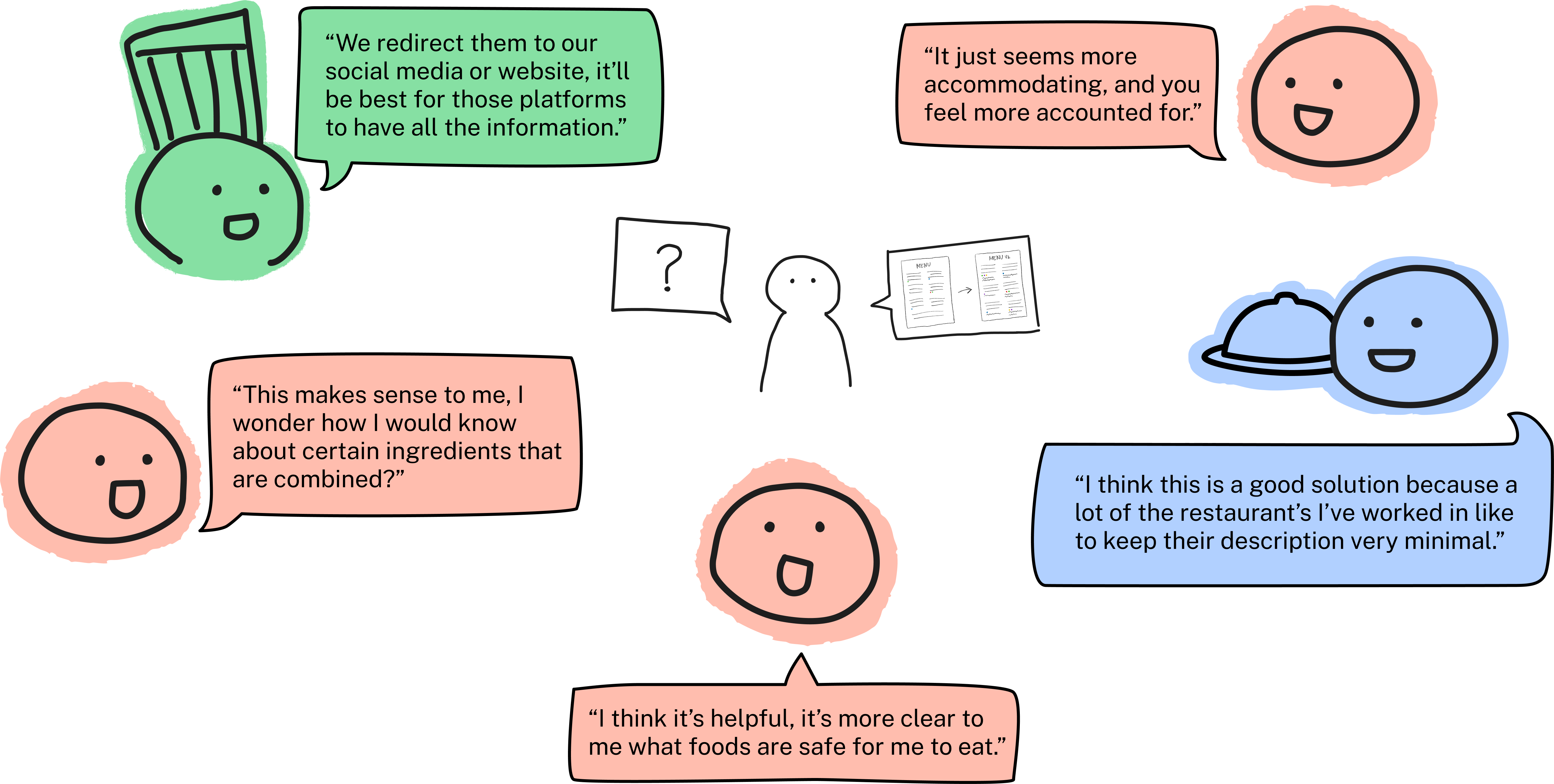
I found that diners with restrictions look to online menus that restaurants provide as a general standard practice. On the other hand, all parties agreed that a detailed menu would make the experience more accommodating and efficient.

Compiling the responses into another affinity map, interviewees provided key considerations beyond making the menu more detailed. Diners talked about elements of "Isolation", "Accessibility", and "Digital vs. Physical Menus"while servers and chefs raised points around "Restaurant Context", "Dish Reconstruction", and "Procedures".

The research efforts revealed requirements, challenges, and perceptions to the solution, across 40 major themes

Analyzing each, I was able to string the findings into coherent insights. Click or hover over the cards below to uncover the most important ones:

Dietary restrictions create feelings of social isolation.

Sharing food with peers and loved ones is an experience those with dietary restrictions often miss out on. Voicing out their dietary needs to others can create feelings of guilt and shame, which only further the feeling of isolation.

"Complexity of Restriction" is the most common barrier to effective communication.

64% of survey respondents cited this reason. Communicating their dietary restriction may involve communicating the reason behind, severity level, and procedures. This is challenging to do in one interaction, let alone with several members of staff.

Online menus have broader implications for customer acquisition and loyalty.

Diners with dietary restrictions often return to the same establishments and recommend them to others in their community. Online menus play the earliest role in persuading these customers to visit in the first place.

Human error is persistent.

Factoring in the biases and limitations of everyone involved in the dining experience, too many uncontrolled variables can affect the safety of a meal. Thus, guaranteeing a safe meal would be irresponsible.

Dish modifications shake up the status quo.

Dishes are founded on long-standing cultural recipes or developed with great thought and effort. Asking to substitute or modify them is perceived to undermine these experiences. Additionally, not every restaurant has the capacity to accommodate these requests. 

Establishing design principles that capture user voices

To address the issues raised through the surveys and interviews, I created three design principles that must be built into the solution.

(1) Create Information, Instead of Promises

Restaurants should provide learning opportunities for diners to make informed decisions. 

(2) Foster Inclusion Through Autonomy

Diners with varying types and levels of dietary restrictions must be able to scan the menu according to their unique needs.

(3) Simplify Provision While Enabling Flexibility

Restaurants must be able to easily provide menus with relevant information, to the best of their circumstance.

Situating the product with people and environment

To remind myself of the users that the solution will serve, I created two personas representing the diner and restaurant.

I also created a to-be service blueprint, which imagines the ideal way in which service components interact with each other. This allowed me to identify different stages where the solution can exist.

Brainstorming possible solution forms with a crazy 8's exercise

Armed with the principles, personas, and blueprint, I sketched different approaches to the problem without restrictions of feasibility. Out of the ten ideas, I found that combining the menu builder and consultancy was the best option.

This specific combination of solutions satisfies multiple considerations, including the scope I was working with. As my expertise is centered around digital design, I decided to focus on developing the menu builder.

Examining existing solutions in the online menu landscape

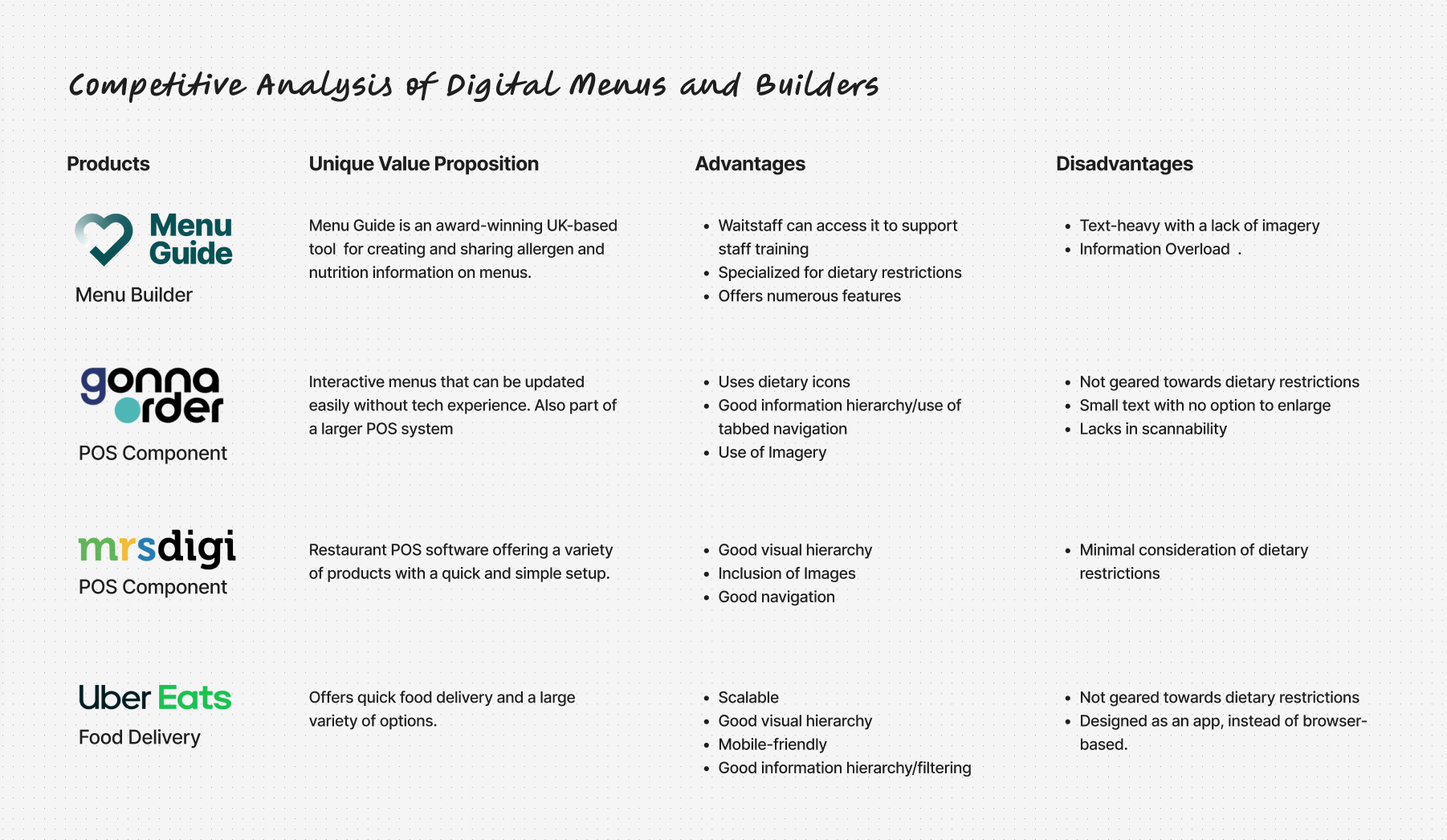
The first step to creating the menu builder is designing its output, the interactive online menu. I looked to similar products (ex: Menu Builders, POS ordering interfaces, etc.), which allowed me to brainstorm several features that satisfy user needs, gaps to fill, and qualities to emulate.

In this time, I found a competitor with a very similar value proposition to mine called MenuGuide, which operates in the UK. This proves the viability of my product, which I only need to tailor to the Canadian landscape. 

Creating online menu features and prioritizing them for development

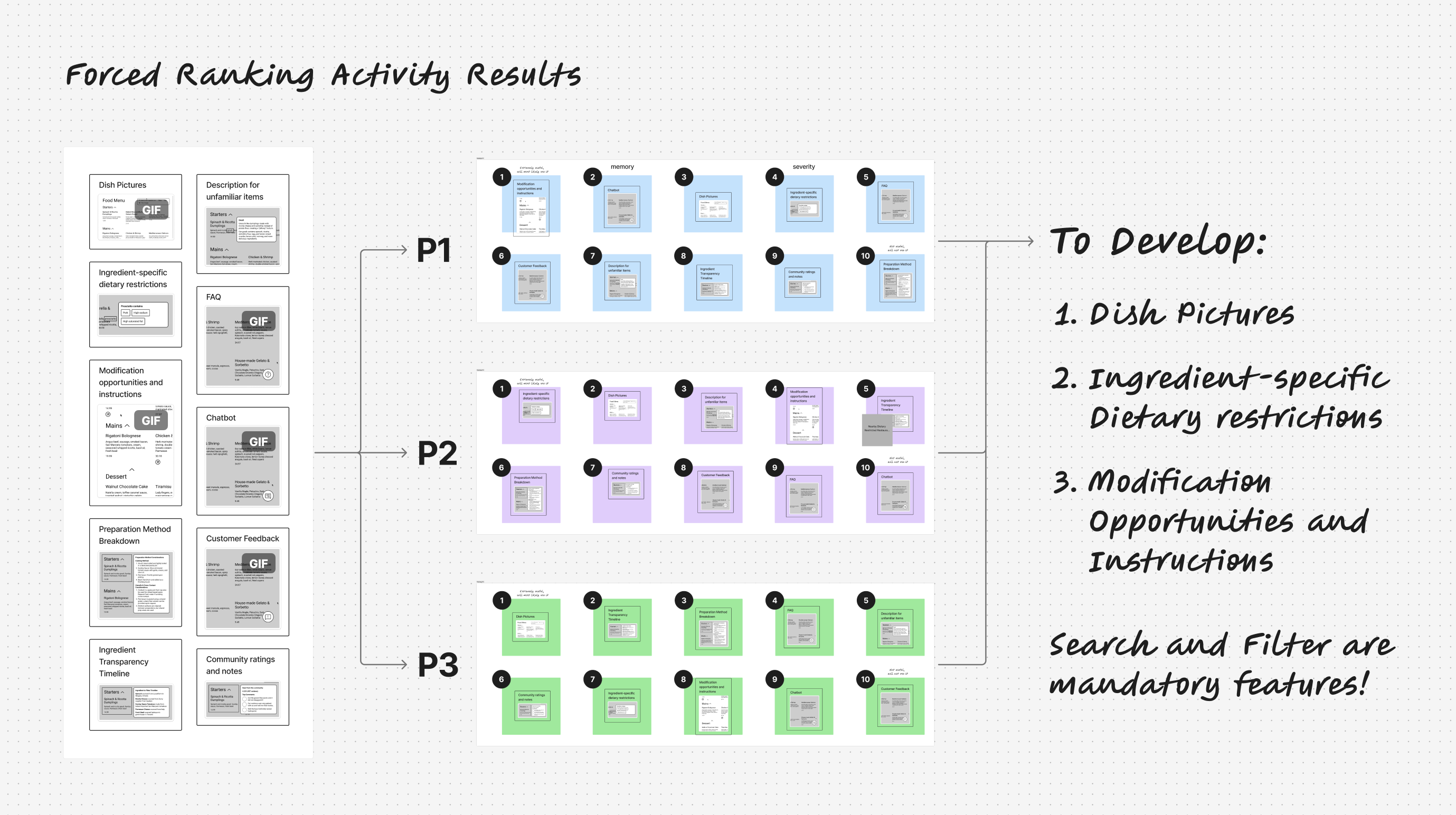
With the brainstormed features, I had users rank them from least to most relevant in a forced ranking activity. Doing this, I prioritized features for an MVP product, identified some more considerations, and understood the users mental models.

Defining the MVP user experience flow

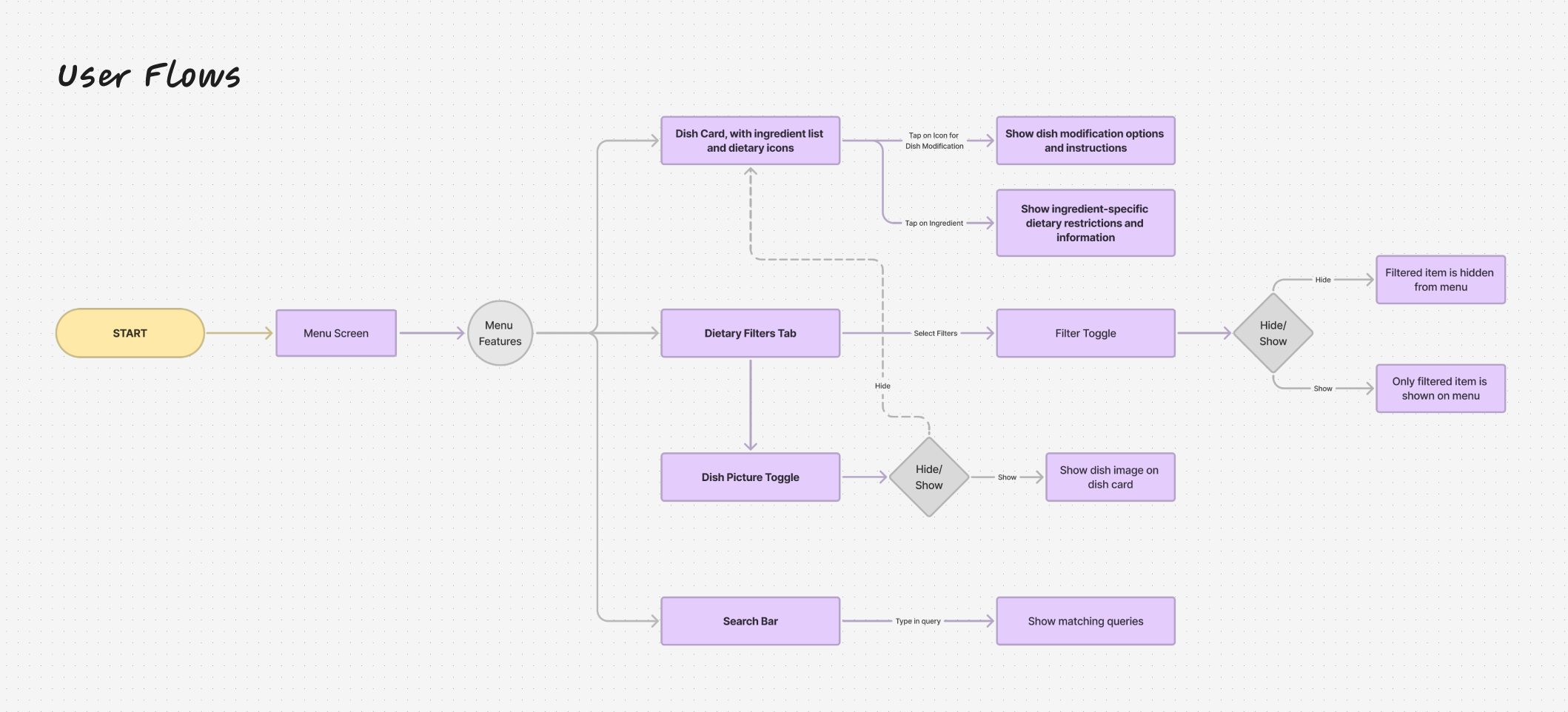
Using the list of prioritized features, I defined the experience that the high-fidelity prototype will demonstrate. This first version emphasizes providing information and supporting users in finding information relevant to them.

Creating mid-fidelity wireframes, with iterative user feedback

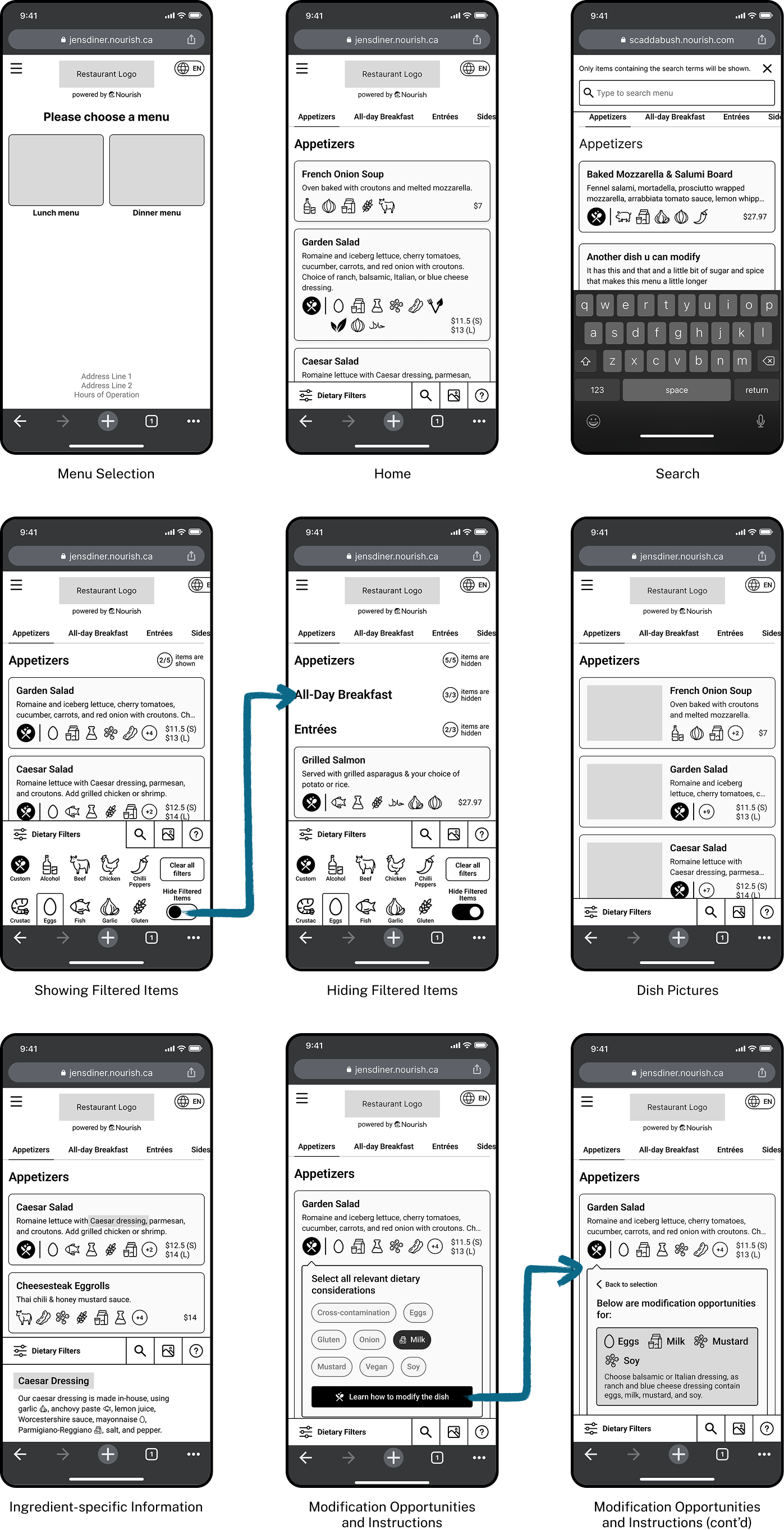
Working off the user flows, I created mid-fidelity wireframes, which went through several rounds of rapid iterative testing and evaluation with users to quickly improve on the design.

Defining the visual language for the menu output and menu builder

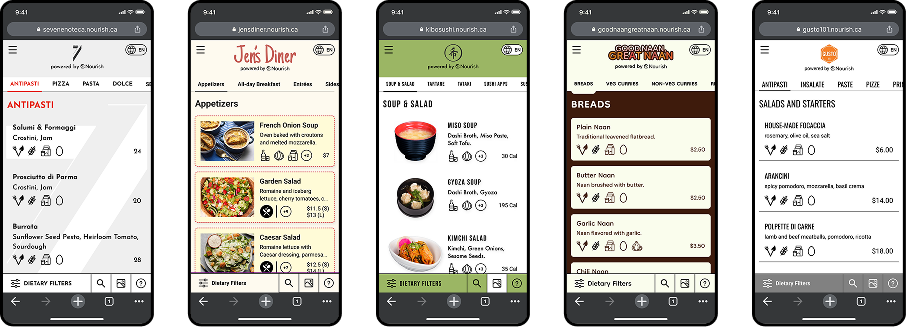
A main feature of the menu design is allowing restaurants to incorporate their branding. To balance brand expression and accessibility, I selected system-friendly typefaces and iconography that captures all key Canadian dietary restrictions.

Examples of real and hypothetical restaurant branding being applied to the menu.

On the other hand, the brand of the menu builder centers around the design principles, conveying the adjectives "comprehensive, accommodating, and structured".

I decided to name the brand "Nourish", which means to provide with the food or other substances necessary for growth, health, and good condition (Oxford Dictionary). Nourish's substance is information.

Introducing

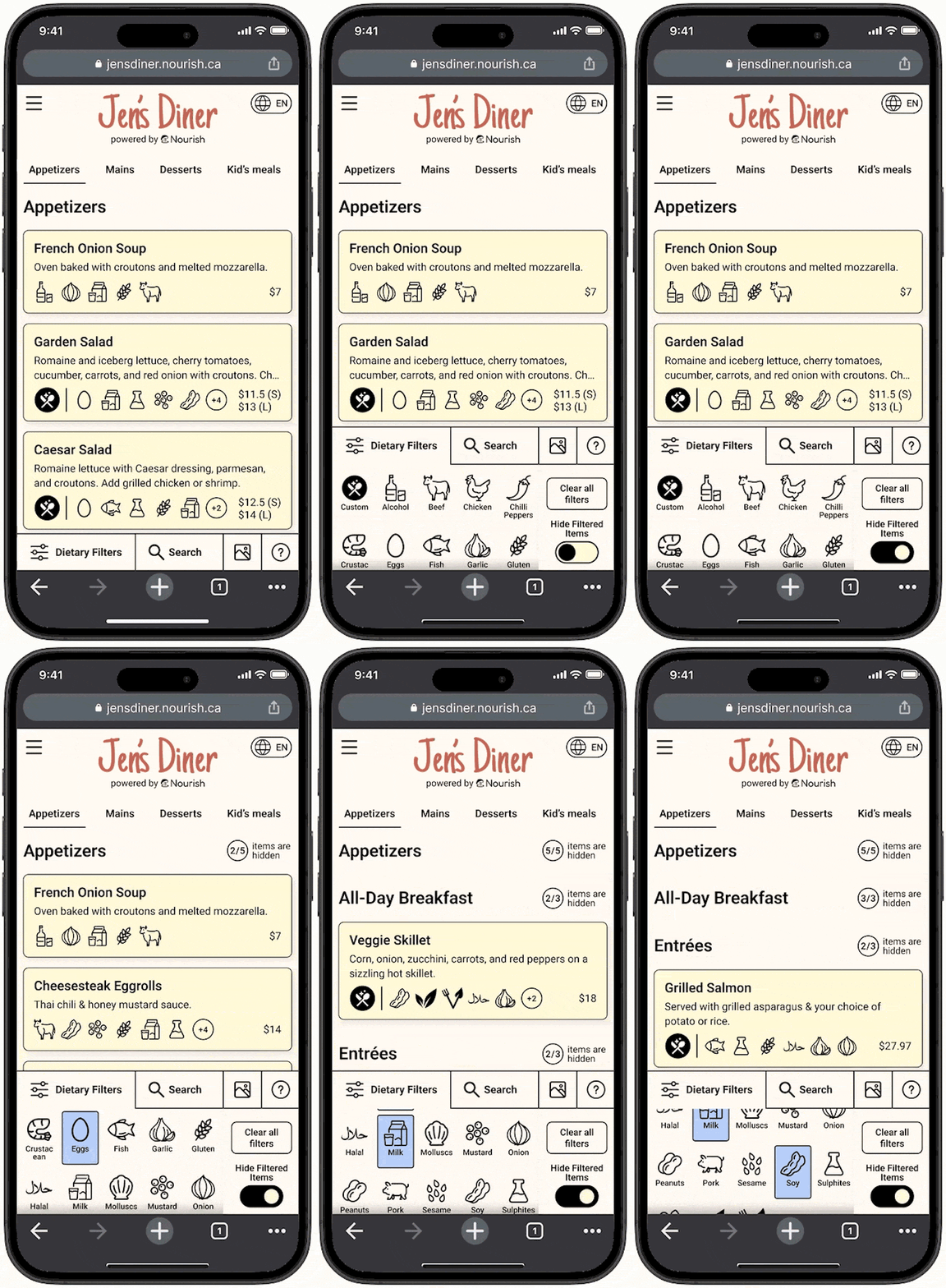
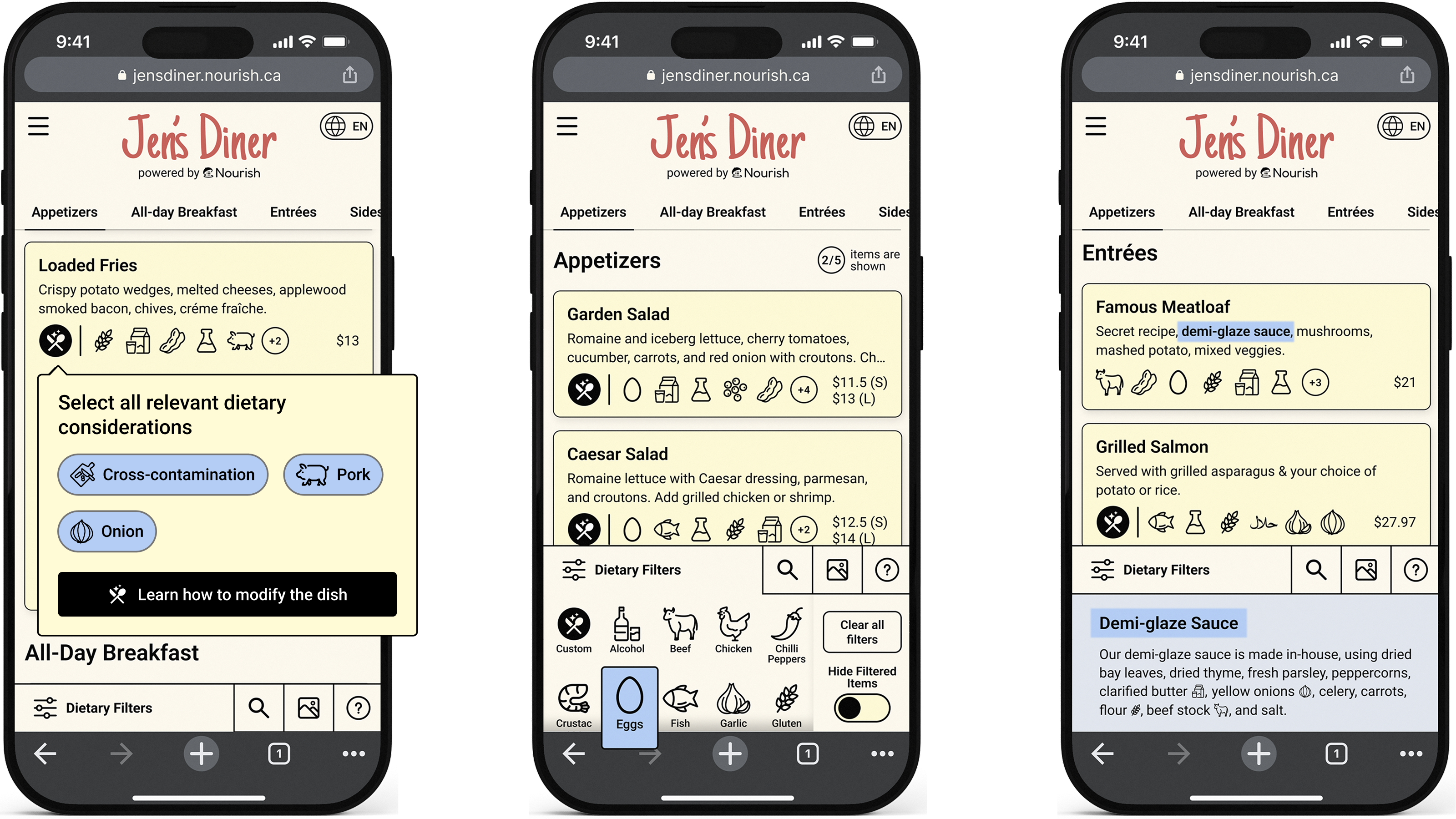
Find Information Fast

Use filters, search, and dietary icons to locate promising dishes.

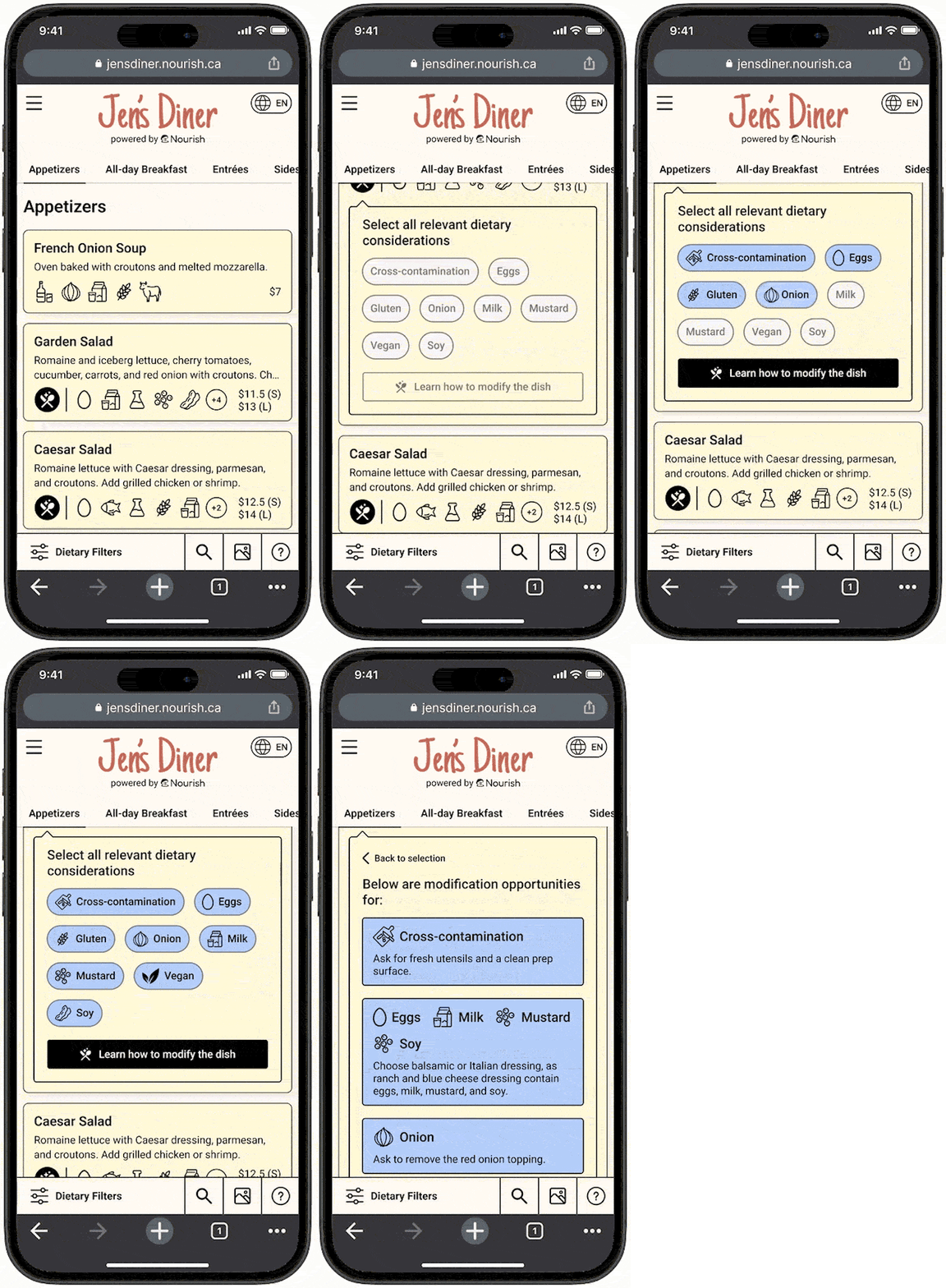
Tailor it to Your Needs

Get instructions for ordering and modifying dishes according to your dietary needs.

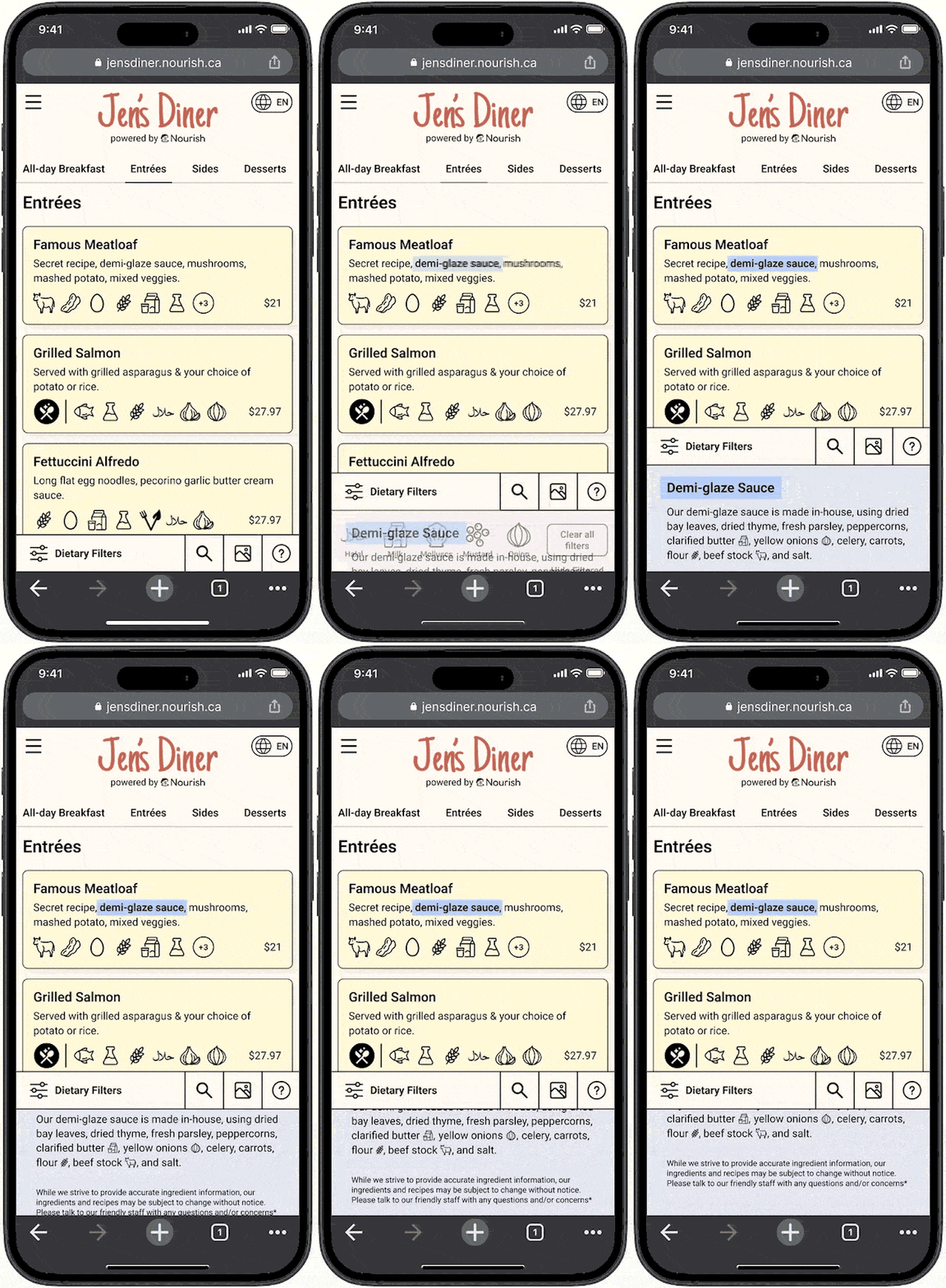
Learn Dish Details

Find ingredient-specific information to support decision making (because what the heck is in worcestershire).

Next steps

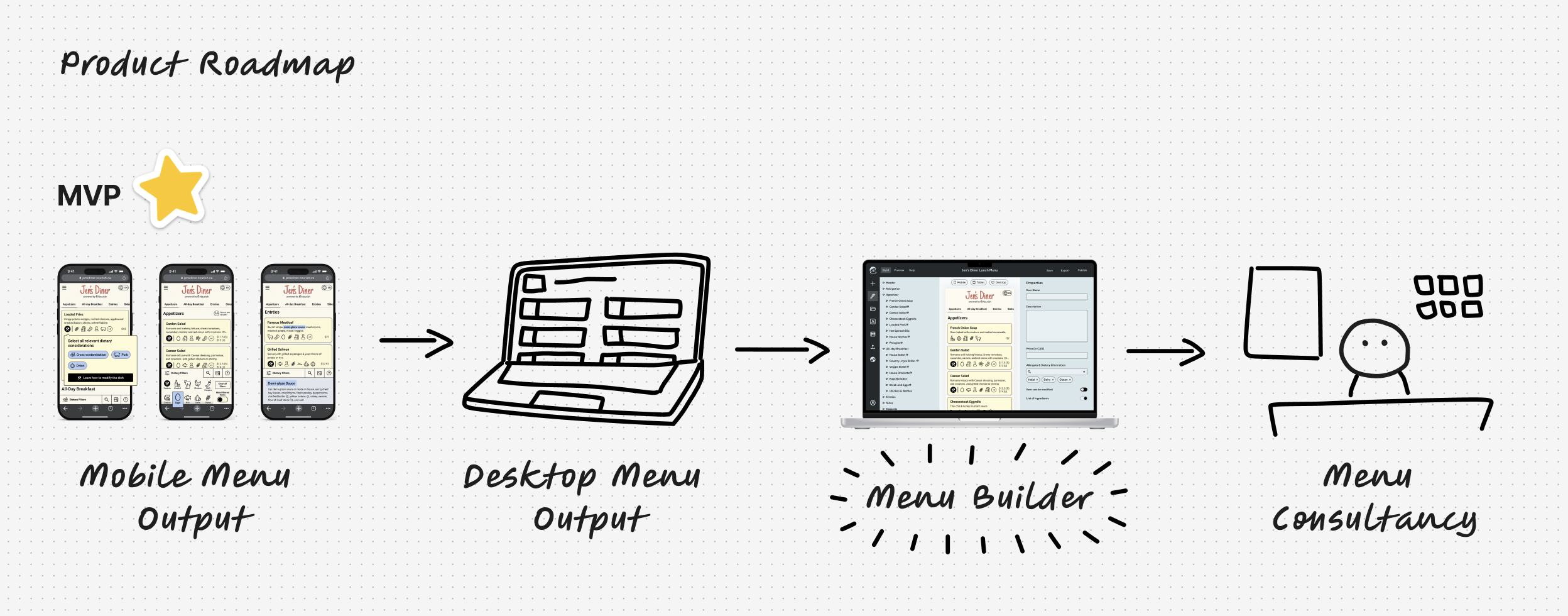
In this project, I focused on developing menu output as the first step toward the menu builder. My next course of action is to test the prototype and refine the design. Below is the product roadmap towards the final product offering.

Takeaways

Seeing AI as a thinking partner, not replacement

At first, I was skeptical that AI would help me analyze quantitative data. After reframing it as a thinking partner, I found it helped me catch unaccounted considerations and save time.

Grounding solutions in the real world lends credibility

Beyond consulting actual users, steps like applying the branding of real restaurants onto my wireframes helped reinforce that my product is viable in the real world.

Gaining expertise in selecting research and design methods

Being able to explore and use different methods allowed me to identify the appropriate one to apply for specific phases of the project.